Energy-Efficient MEP Design in Kansas City
Cut Utility Costs Up to 30% With MEP Systems Designed for Simplicity, Performance, and Lasting Savings
Every building owner in Kansas City knows the sting of opening a utility bill that keeps climbing, month after month, year after year.
Between the region's punishing summer heat and bitter winter cold, HVAC systems in commercial and institutional buildings work overtime. But here's what many owners don't realize: the systems responsible for those rising bills were often over-engineered, poorly coordinated, or designed with complexity that no facility team can realistically maintain. The result is wasted energy, deferred maintenance, and occupants who are still uncomfortable despite the expense.
5BY5 Engineering takes a fundamentally different approach to energy-efficient MEP design. Rather than layering on complicated controls and cutting-edge technology that looks impressive on paper but fails in practice, we design mechanical, electrical, and plumbing systems that achieve aggressive efficiency targets through simplicity. Variable speed drives, right-sized equipment, smart heat recovery, and intuitive controls, all selected and configured so your facility team can actually operate and maintain them without specialized training or expensive service contracts. The savings don't erode over time because the systems are built for the people who run them every day.
For Kansas City building owners and facility managers, this means real, sustained cost reduction, not a one-year performance spike followed by a slow slide back to inefficiency. Our clients have saved over $1 million in unnecessary construction costs and more than $300,000 annually in maintenance fees because our designs eliminate waste at every stage. When your MEP systems are simpler to operate, they stay efficient longer, cost less to maintain, and keep occupants comfortable through every season Kansas City can throw at them.
✔ Saved clients over $1 million in unnecessary construction costs
✔ Helped clients simplify operations, saving over $300,000 yearly in maintenance fees
✔ Helped over 100 owners make buildings more efficient with well-designed MEP systems
✔ Proven experience with Kansas City brewery projects, including City Barrel Brewery and Limitless Brewing
✔ Founded in 2016 by Brock Centlivre, PE, Principal in Charge
Our Services
Energy efficient MEP design is the engineering discipline of designing mechanical, electrical, and plumbing systems that deliver optimal building performance, comfortable temperatures, adequate lighting, reliable water systems, and safe ventilation, while consuming the least possible energy.
At 5BY5 Engineering, this isn't an add-on service or a green checkbox. It's embedded in every design decision we make, from initial load calculations through equipment selection, controls programming, and commissioning verification.
Our process begins with learning. Before we draw a single line, we study your building's unique characteristics: its envelope, its occupancy patterns, its exposure to Kansas City's wide temperature swings, and your operational team's capabilities. We coordinate closely with architects and envelope consultants to ensure the MEP systems and building shell work together, not against each other. A high-efficiency chiller paired with a poorly insulated building is still an expensive building to operate, and we refuse to design in a vacuum.
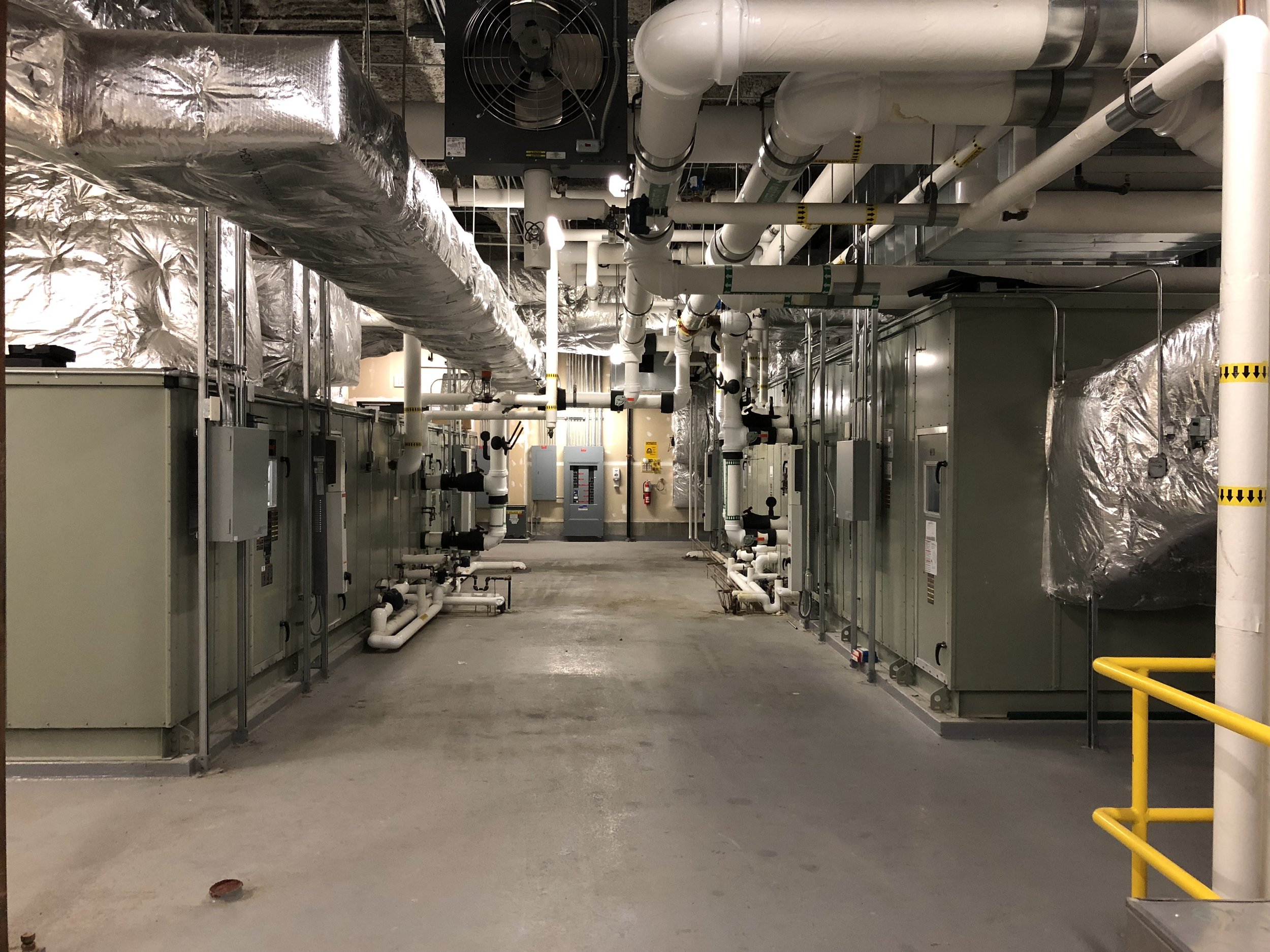
From there, we select and engineer systems that target the largest energy consumers first. High-efficiency HVAC equipment with variable speed drives adjusts output to match real-time demand instead of running at full capacity around the clock. Heat recovery systems capture energy that would otherwise be exhausted and redirect it where it's needed. LED lighting with intelligent occupancy and daylight harvesting controls reduces electrical loads without sacrificing visual comfort. Plumbing systems are designed to minimize hot water waste and reduce pump energy. Every component is chosen not only for its rated efficiency but for its maintainability and operational simplicity.
The outcome is a building that costs measurably less to operate from day one, with savings that compound over time because your team can keep systems performing at their design intent. We provide lifecycle cost analyses that document projected payback periods, and we support measurement and verification strategies so you can track actual performance against projections. For Kansas City facilities facing rising utility rates and tightening energy codes, this isn't aspirational; it's essential.
Start Cutting Your Building's Energy Costs
how you benefit
-
Energy costs are typically the single largest controllable operating expense for commercial buildings in Kansas City. When HVAC systems are oversized, a surprisingly common problem, they cycle inefficiently, waste electricity, and wear out faster. When they're undersized, they run constantly and still can't maintain comfort. Either way, your utility bills are higher than they need to be.
5BY5 Engineering's approach to energy efficient MEP design starts with precise load calculations that account for your building's actual conditions: its orientation, envelope performance, internal heat gains, occupancy schedules, and Kansas City's specific climate data. We then select equipment, chillers, boilers, air handling units, pumps, and fans, that matches the real load profile, not a worst-case assumption inflated by safety factors stacked on safety factors.
The impact is immediate and measurable. Right-sized equipment operates closer to its peak efficiency point for more hours of the year. Paired with variable speed drives that modulate fan and pump speeds to match real-time demand, energy consumption drops dramatically compared to constant-volume legacy systems. Our clients routinely see utility reductions of 20–30% compared to code-minimum designs, and those savings show up on every monthly bill for the life of the building. Over a 15- to 20-year equipment lifecycle, this translates to tens or hundreds of thousands of dollars returned to your operating budget, money that can fund other capital improvements, reduce tenant costs, or simply improve your bottom line.
-
Energy efficiency and occupant comfort are not competing priorities, in fact, the opposite is true. Inefficient systems are almost always uncomfortable systems. Oversized equipment short-cycles, creating temperature swings and humidity problems. Poorly controlled systems blast conditioned air into empty rooms while occupied spaces go unserved. When efficiency and comfort both suffer, tenants complain, employees lose productivity, and patients in healthcare settings experience real quality-of-care impacts.
5BY5 Engineering designs MEP systems that deliver consistent, responsive comfort precisely because they're efficient. Variable air volume systems adjust airflow zone by zone based on actual occupancy and thermal loads. Dedicated outdoor air systems decouple ventilation from heating and cooling, giving you independent control over air quality and temperature. Properly staged heating and cooling equipment modulates smoothly instead of lurching between on and off. The result is tighter temperature control, better humidity management, and quieter operation, the things occupants actually notice and care about.
In Kansas City's climate, where summer dew points frequently climb into the uncomfortable range and winter temperatures can swing 30 degrees in a day, this kind of responsive system design is especially critical. Buildings designed with 5BY5's efficiency-first approach don't just cost less to run, they feel better to be in. For building owners, that means higher tenant satisfaction, lower vacancy rates, fewer comfort complaints for facility teams to chase, and a reputation for quality that supports long-term asset value.
-
The dirty secret of energy efficient building design is that many "high-performance" buildings stop performing within a few years. Complex controls sequences drift out of calibration. Sophisticated equipment requires specialized technicians that facility budgets can't support. Override after override accumulates until the building automation system is running in manual mode and nobody remembers the original design intent. The efficiency that was promised on paper never materializes in practice, or it evaporates within 24 months.
This is the problem 5BY5 Engineering was founded to solve. Our core philosophy is that the best MEP system is one your team can actually operate, maintain, and understand. We don't design the most technically complex system we can imagine, we design the most effective system your people can sustain. That means selecting controls strategies that are powerful but intuitive. It means specifying equipment with local parts availability and service support in the Kansas City area. It means writing sequences of operation in plain language and training your team on how the building is supposed to run.
The payoff is efficiency that persists. When operators understand their systems, they maintain them properly. When controls are straightforward, they don't get overridden. When equipment is reliable and locally serviceable, it stays online. Our clients have saved over $300,000 annually in maintenance fees, not because we installed exotic technology, but because we eliminated unnecessary complexity. In a market where skilled facility operators are increasingly hard to find and retain, designing for operational simplicity isn't a luxury, it's the only responsible engineering strategy.
-
One of the most overlooked aspects of energy efficient MEP design is the financial incentive landscape. Utilities serving the Kansas City metropolitan area, including Evergy and Missouri Gas Energy, offer rebate programs for commercial customers who install high-efficiency equipment and implement energy-saving measures. These rebates can offset a significant portion of the incremental cost of upgrading from code-minimum to high-performance systems, dramatically shortening your payback period.
5BY5 Engineering builds rebate and incentive capture into the design process from the start, not as an afterthought. During equipment selection, we evaluate which options qualify for prescriptive rebates, fixed dollar amounts for specific equipment types like high-efficiency chillers, boilers, variable frequency drives, and LED lighting. For more complex projects, we pursue custom or performance-based rebates that reward verified energy savings above code baselines. We handle the documentation, energy modeling, and coordination with utility program administrators so the process is seamless for you.
The financial impact can be substantial. Depending on the scope of your project, rebates can cover 10–25% of the cost of efficiency upgrades, turning a three-year payback into a two-year payback, or even less. Combined with reduced operating costs from day one, energy efficient MEP design becomes not just a smart environmental decision but a financially superior investment. For Kansas City building owners weighing capital improvement budgets, capturing every available dollar of incentive funding isn't optional, it's essential to maximizing your return.
-
Energy codes are getting stricter. Kansas City and the state of Missouri have been progressively adopting more stringent versions of the International Energy Conservation Code, and the trajectory is clear: efficiency requirements will only increase. Buildings designed to barely meet today's code minimum risk becoming non-compliant, or at least competitively disadvantaged, within a few code cycles. Meanwhile, utility rates in the Kansas City metro have increased steadily, and there's no indication that the trend will reverse.
5BY5 Engineering designs MEP systems that don't just meet current energy codes, they exceed them with enough margin to remain high-performing as standards evolve. We accomplish this not through exotic or experimental technology but through proven, maintainable strategies: high-efficiency equipment, effective heat recovery, smart zoning, envelope-coordinated design, and right-sized distribution systems. These are strategies that work today and will continue to work as codes tighten, because they're based on fundamental engineering principles rather than regulatory workarounds.
For building owners and facility managers in Kansas City, this forward-looking approach protects your investment. Buildings that already exceed code requirements face lower retrofit costs when new standards take effect. They command higher lease rates and sale prices because tenants and buyers increasingly value operating efficiency. And they're better positioned to integrate renewable energy systems, solar photovoltaics, battery storage, or electrification strategies, as those technologies become more cost-effective. Designing for efficiency today is designing for relevance tomorrow. 5BY5 ensures your building is ready for both.
-
High-efficiency MEP systems don't just save energy, they last longer and cost less to maintain. This is one of the most underappreciated benefits of thoughtful, efficiency-driven design: equipment that runs at the right capacity, at variable speeds matched to actual load, experiences dramatically less mechanical stress than equipment that's oversized and short-cycling or undersized and running at full tilt around the clock.
Consider a variable speed chiller plant designed by 5BY5 Engineering compared to a conventional constant-speed system. The variable speed system modulates compressor, pump, and fan speeds to match the building's real-time cooling load. At part-load conditions, which represent the vast majority of operating hours in Kansas City's transitional spring and fall seasons, the equipment runs at reduced speeds, generating less heat, less vibration, and less wear on bearings, motors, and mechanical seals. The result is fewer breakdowns, longer intervals between major maintenance events, and extended equipment life that can add 5–10 years beyond the typical replacement cycle.
For facility managers, this means fewer emergency repair calls, more predictable maintenance budgets, and less downtime. For building owners, it means deferring expensive capital equipment replacements and improving net operating income. 5BY5's commitment to operational simplicity amplifies these benefits further: when systems are straightforward to maintain, preventive maintenance actually gets done on schedule instead of being deferred because the system is too complicated for available staff. The compounding effect of better equipment, simpler maintenance, and longer service life makes energy-efficient design one of the highest-return investments a building owner can make.
OUR SERVICE Categories
High-Efficiency HVAC Systems Design:
We design heating, ventilation, and air conditioning systems that target the largest energy consumers in your building. From variable refrigerant flow systems to high-efficiency chiller plants with variable speed drives, every component is selected for peak performance and operational simplicity. Our HVAC designs account for Kansas City's demanding climate to deliver comfort and savings year-round.
Building System Optimization:
Existing buildings often have significant untapped efficiency potential hidden in outdated controls, mismatched equipment, or systems that have drifted from their design intent. 5BY5 evaluates your current MEP systems, identifies the highest-impact opportunities, and designs targeted upgrades that deliver measurable energy reduction without full system replacement.
Renewable Energy Integration:
As solar photovoltaics, battery storage, and building electrification become increasingly viable in the Kansas City market, 5BY5 designs MEP systems that are ready for integration. We ensure your electrical infrastructure, load profiles, and control strategies are compatible with renewable energy additions, whether you're installing them now or planning for the future.
Commissioning for Sustained Performance:
Our commissioning services verify that your new or upgraded MEP systems are installed correctly, calibrated properly, and operating as designed. This critical quality assurance step closes the gap between design intent and real-world performance, ensuring the efficiency you paid for is the efficiency you actually get from day one and beyond.
Energy Modeling and Lifecycle Cost Analysis:
We provide detailed energy modeling and lifecycle cost analysis that quantifies the financial return of efficiency investments. Our models project utility savings, maintenance cost reductions, equipment replacement timelines, and rebate capture, giving you the data you need to make confident capital decisions.
OUR process
STEP ONE
Learn Your Building and Your Goals
We start every energy-efficiency engagement the same way: by learning. Before any design work begins, our engineers study your building's physical characteristics, existing systems, operational patterns, utility history, and energy cost structure. We meet with your facility team to understand their capabilities, pain points, and daily realities. We review your building envelope, occupancy schedules, and any planned renovations or expansions. This discovery phase typically takes one to two weeks and involves a site visit, utility data analysis, and stakeholder interviews. The goal is to ensure every design decision that follows is grounded in your building's actual conditions, not assumptions.
STEP TWO
Identify and Prioritize Efficiency Opportunities
With a thorough understanding of your facility, we conduct an engineering analysis to identify where the greatest energy savings opportunities exist. This includes evaluating HVAC system performance, lighting loads, plumbing energy use, controls effectiveness, and envelope interactions. We rank opportunities by energy impact, implementation cost, and payback period, then present them to you with clear lifecycle cost projections. This phase takes approximately two to three weeks and results in a prioritized roadmap you can implement all at once or in phases based on your budget and schedule.
STEP THREE
Design Systems for Efficiency and Simplicity
Once priorities are established, our engineering team designs the MEP systems, or system upgrades, that will deliver your target energy performance. Equipment is selected for high efficiency, local serviceability, and operational simplicity. Controls strategies are developed to be powerful yet intuitive for your staff. We coordinate with architects, structural engineers, and contractors to ensure seamless integration. Design timelines vary by project scope but typically range from four to twelve weeks. Throughout, you receive regular updates and design reviews to ensure alignment with your goals.
STEP FOUR
Commission, Verify, and Train
After construction, our commissioning process verifies that every system is installed correctly, calibrated to design specifications, and performing as intended. We conduct functional performance testing, review controls sequences, and document baseline energy performance. Equally important, we train your facility team on how the systems work, how to maintain them, and what to watch for. This step typically spans two to four weeks post-construction and includes a written commissioning report and operator training materials. The result is a building that performs at its design efficiency from the first day of occupancy.
STEP FIVE
Measure, Verify, and Optimize Over Time
Energy efficiency isn't a one-time event; it's an ongoing commitment. We establish measurement and verification protocols that let you track actual energy performance against projections. If performance drifts, you'll know early and can take corrective action before savings erode. We also provide guidance on utility rebate verification documentation and can support ongoing retro-commissioning efforts as your building's needs evolve. This ongoing relationship helps you keep the efficiency gains you invested in delivering year after year.
Our APPROACH
At 5BY5 Engineering, our approach to energy-efficient MEP design is rooted in a conviction that has guided us since our founding: the best building systems are the ones that actually work as intended, not just on commissioning day, but five, ten, and twenty years later.
We've seen too many "high-performance" buildings fail to deliver on their efficiency promises because the systems were designed to impress other engineers rather than serve the people who operate them. Our philosophy is different. We design for sustained performance through deliberate simplicity.
This doesn't mean we avoid advanced technology. It means we apply it strategically. A variable frequency drive on an air handling unit is a proven, maintainable efficiency strategy that any competent facility operator can understand and service. A bespoke, multi-layered optimization algorithm that requires a controls specialist to troubleshoot every time something goes wrong is not, at least not for most buildings. We select the approach that achieves the efficiency target with the least operational burden, because that's the approach that will still be working correctly when no one is watching.
Our engineering methodology integrates energy performance with every other design consideration, constructability, first cost, maintenance access, equipment lead times, and code compliance. We don't design the MEP systems in isolation and then check the energy box at the end. Efficiency is a design driver from the first sketch, influencing equipment selection, system architecture, distribution layout, and controls strategy simultaneously. This integrated approach is why our clients consistently realize savings that meet or exceed projections.
Kansas City's climate and building stock present specific challenges, extreme temperature ranges, aging infrastructure, tight capital budgets, and a limited pool of specialized facility operators. 5BY5 understands these realities because we work in this market every day. Our designs reflect local conditions, local utility rate structures, local code requirements, and the real-world capabilities of local facility teams. That's not something a national firm flying in for a single project can replicate. It's the advantage of working with engineers who are invested in the same community as you.
FREQUENTLY ASKED QUESTIONS
5BY5 Engineering was founded in 2016 by Brock Centlivre and is headquartered in downtown Kansas City, Missouri. The firm specializes in mechanical, electrical, and plumbing engineering with a focus on simplifying building operations to deliver lasting efficiency, reliability, and comfort. Having helped over 100 building owners optimize their facilities across healthcare, retail, hospitality, and government sectors, 5BY5 brings deep local expertise to every project in the Kansas City metropolitan area. Learn more about our team and approach.
-
Savings vary based on building type, size, age, and existing system conditions, but our clients typically see utility cost reductions of 20–30% compared to code-minimum designs. For existing buildings receiving system upgrades, savings can be even more dramatic if current systems are significantly outdated. We provide project-specific energy modeling and lifecycle cost analysis so you can see projected savings before committing to any design.
-
Most energy efficiency upgrades we design achieve payback within two to five years, depending on scope and available utility rebates. Simpler measures like LED lighting retrofits and variable speed drive installations often pay back in under two years. More comprehensive system replacements take longer but deliver larger cumulative savings over the equipment's 15–25 year lifespan. We always provide payback calculations as part of our design recommendations.
-
Not the way we design them. 5BY5 Engineering's core differentiator is designing efficient systems that are simpler to operate, not more complex. We select equipment and controls strategies based on your team's capabilities and provide thorough training at project completion. Our clients have actually reduced maintenance costs by over $300,000 annually because simpler systems require less specialized service and experience fewer breakdowns.
-
Yes. We identify applicable rebate programs from local utilities including Evergy and Missouri Gas Energy during the design phase and select equipment that maximizes your rebate eligibility. We handle the documentation, energy calculations, and utility coordination required to secure both prescriptive and custom performance-based rebates, ensuring you capture every available dollar to offset your project costs.
-
Energy efficient design applies to both new construction and existing buildings. In fact, existing buildings often present the greatest savings opportunities because they may have outdated, oversized, or poorly controlled systems. 5BY5 Engineering specializes in evaluating existing facilities, identifying the highest-impact upgrades, and designing phased improvement plans that align with your budget and operational schedule.
Efficient Buildings Start Here
Let 5BY5 Engineering design MEP systems that cut your costs and keep your building comfortable, for good.